Blog
Community as the Catalyst: Jodeme Goldhar, Cormac Russell and Dr. Sacha DeWolfe on Creating Lasting Change
Reflections on a conversation with The Connected Community podcast.
The Centre for Systems Collaboration
Every community holds untapped potential, and with it, real opportunity to improve health and wellbeing.
Within neighbourhoods, families, organizations and sectors there is wisdom, care, skill and relationship waiting to be connected. When that potential is seen and woven together, people experience belonging, and health and wellbeing can take root in ways that last.
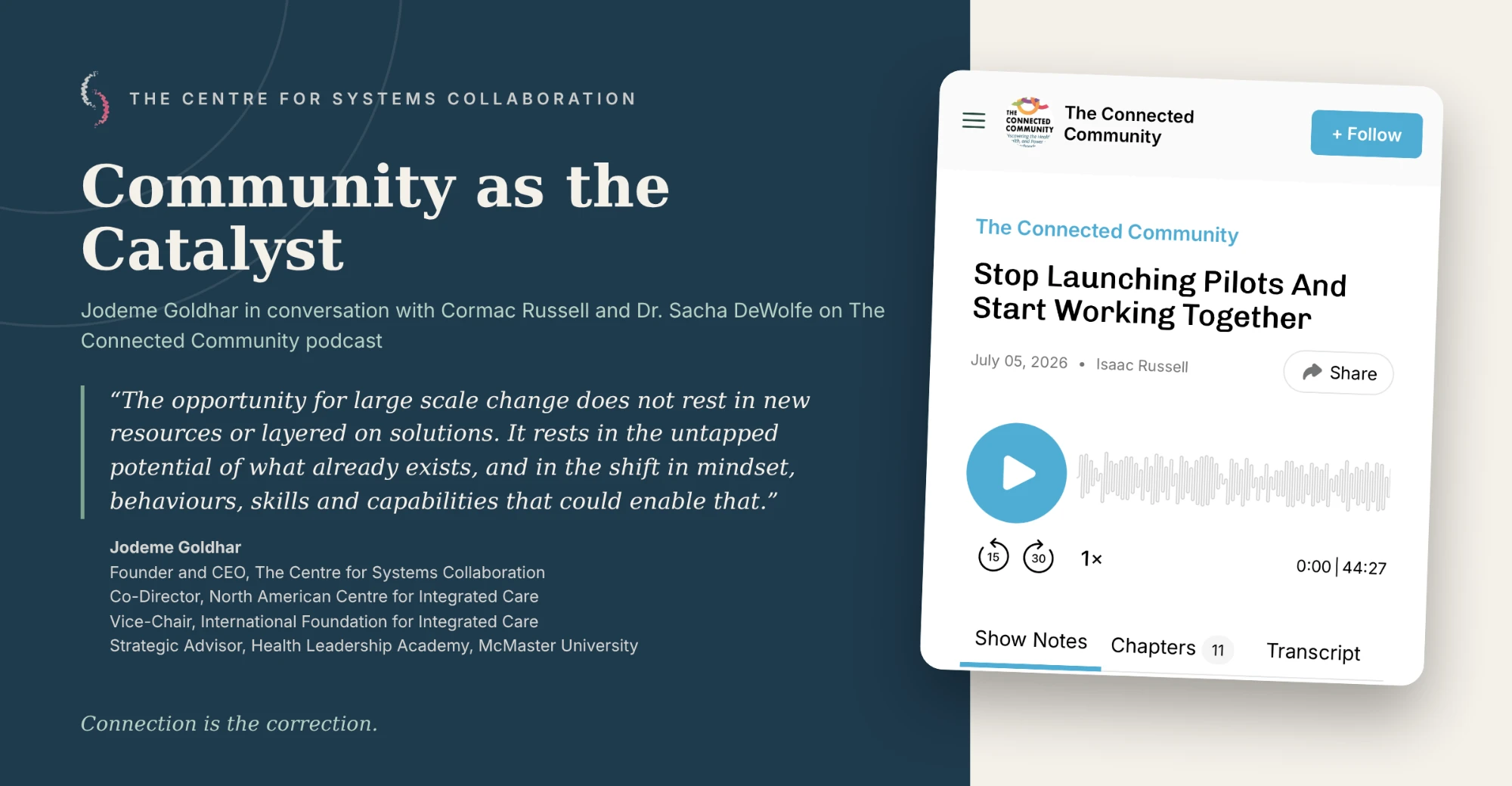
This shared conviction sits at the heart of a recent conversation between our Founder and CEO, Jodeme Goldhar, and hosts Cormac Russell and Dr. Sacha DeWolfe in the episode Stop Launching Pilots and Start Working Together on The Connected Community podcast.
The Connected Community celebrates people around the world who are working, discovering and thriving in community spaces. Through these conversations, Cormac and Sacha invite listeners to reimagine community as the driver of the good life.
What emerged in this episode was a recounting of ideas, and also a glimpse of two leaders whose life’s work has been moving toward the same horizon from different directions.
Where it begins
Jodeme’s path into this work began in her early teens, through her closeness with her great grandmother.
Wanting to support her, Jodeme started volunteering with older adults and their families. She heard again and again how hard it was for them to find their way through care that was meant to help them.
Those conversations stayed with her. They showed her that good people working in good organizations can still leave people and their families feeling unseen, and that what matters most to people is often lost in the space between services.
That early understanding continues to guide her. For Jodeme, this work is about seeing people, creating belonging, and holding health and wellbeing as a shared responsibility we carry for one another.
Two traditions, one horizon
Jodeme and Cormac first met on a shared stage in Hamburg in 2015. Cormac was speaking about asset based community development, and Jodeme about integrated care and population health.
They recognized almost immediately that they were speaking the same truth in different accents, and a lifelong friendship and collaboration began.
Cormac has devoted his career to helping communities discover and connect the gifts already present among them.
As managing director of Nurture Development and European director of the Asset Based Community Development Institute at DePaul University, and as coauthor with John McKnight of The Connected Community, he has shown communities around the world how neighbourliness, relationship and local wisdom become powerful forces for renewal. His vision places community at the centre, with services standing in support.
Jodeme carries that same belief into the architecture of health and social care.
Through her leadership with the International Foundation for Integrated Care, the University of Toronto’s North American Centre for Integrated Care, McMaster University’s Health Leadership Academy and the Centre for Systems Collaboration, she works with leaders, boards, organizations and communities to connect what exists so that it can serve what matters most to people and their families.
Together, they hold a view of the world grounded in abundance. Our communities, organizations and sectors already hold extraordinary resources.
What so often keeps people experiencing scarcity is the distance between those resources. The greatest opportunity for large scale change lies in the untapped potential of what already exists, and in our willingness to shift our mindsets, behaviours, skills and capabilities so we can connect it.
“The opportunity for large scale change does not rest in new resources or layered on solutions. It rests in the untapped potential of what already exists, and in the shift in mindset, behaviours, skills and capabilities that could enable that.”
Jodeme Goldhar
Founder and CEO, The Centre for Systems Collaboration, a division of 4C Impact
Co-Director, North American Centre for Integrated Care (NACIC), IFIC Canada and the Network for Integrated Care Excellence (NICE), University of Toronto
Vice-Chair, International Foundation for Integrated Care (IFIC)
Strategic Advisor, Health Leadership Academy, and Co-Director, National Health Fellows and Collaborative Governance Programs and Canada Health Transformation Lab, McMaster University
From caring for people to caring for communities
Jodeme describes a continuum.
Integrated care brings people together across organizations as one team around the goals of a person and their family, and the evidence shows it improves experience, outcomes and the wellbeing of those providing care.
Population health asks something deeper of us. It invites communities to define their own health and wellbeing goals and invites every organization and sector to ask how it might be in service of those goals.
This is where Cormac’s and Jodeme’s worlds meet most fully. When communities name what matters to them and systems reorient around it, people move from being recipients of care to being recognized as creators of their own health and belonging.
Why lasting change asks more of us
Jodeme names a provocation with care and conviction: the status quo is no longer sufficient to enable health and wellbeing.
Our organizations are built with good intention, each with its own strategic plan, board, accountabilities and performance expectations. Taken together, these structures can quietly hold fragmentation in place, even when every leader in the room wants to collaborate.
Sacha shared a story that shows why this matters so much.
Working alongside an Indigenous community, she helped deliver a home cleaning training program that the community itself had asked for, so it could build skills among its own people instead of paying outside contractors.
The benefits reached well beyond clean homes. Homes free of mould and leaks meant better health, healthier environments for children and lower housing costs. Participants were trained, came off social assistance and never missed a day.
Then the program ended. The departments that could each see the value were expected to share the cost of continuing it, and the work stalled. The participants were honoured at a ceremony, yet the very thing that had changed their lives had nowhere to go.
For Sacha, the lesson runs deeper than funding. In Indigenous communities, learning, health and wellbeing are understood as whole, and the services that come into community need to work the same way. When each department holds only its own piece, a program that serves the whole person has no natural home.
It is a story many communities will recognize, and Sacha put the question to Jodeme plainly:
“Communities learn, thrive, their health, their wellbeing, everything is holistic. So, every service that is coming to Indigenous communities needs to be that way, because that’s how it functions. … What are the biggest barriers to breaking down those silos across health, education and housing?”
Dr. Sacha DeWolfe
Co Host, The Connected Community podcast
Jodeme’s answer speaks directly to Sacha’s story.
When collaboration lives on the side of someone’s desk, or depends on a short term grant, the work struggles to endure.
Lasting change asks that collaboration be hardwired into how we govern, plan and lead together, so that it becomes part of how we operate.
The opportunity in front of us
Sacha then asked the question so many leaders are holding:
“What is one practical step that you could tell an organization to take tomorrow to move toward more community centred approaches?”
Dr. Sacha DeWolfe
Co Host, The Connected Community podcast
Jodeme offers two places to begin.
Support whole ecosystems to learn together, so that people across organizations, sectors and communities can learn, unlearn, grow and have impact together as a community of changemakers.
Ask boards and executive leaders to commit to at least one shared strategic priority, anchored in what matters most to community, with accountability for population health outcomes reflected in governance and leadership.
She also invites each of us into a moment of honest reflection.
When she asks groups how collaborative they are, people rate themselves highly. When she asks about their organizations, sectors and partners, the ratings fall.
Yet every organization and every sector is made of us. The capacity to change how we work together already lives within each of us, and that is where the movement begins.
An invitation to the collective
At the Centre for Systems Collaboration, our purpose is to create the enabling conditions for large scale collaborative change, working alongside leaders, organizations, sectors, communities and people with lived and living experience.
Conversations like this one remind us how many people around the world are ready to walk together toward the same horizon.
If this work speaks to you, listen to the full episode and share it with a colleague who is holding this work in their own community.
We would love to hear what it sparks for you, and to explore what we might create together that none of us could create alone. You can reach us at connection@centreforsystemscollaboration.com.
Connection is the correction.
With gratitude,
The Team at the Centre for Systems Collaboration